
Most people leave nothing behind, not because they don't want to, but because there was never a good time to think about it.
Stillwith is a mobile app that lets you record voice notes, capture photos, and write messages for the people you love, to be delivered after you're gone. A trusted contact confirms when the time comes, and your memories reach the people they were meant for.
The idea came from earlier research into how people memorialize loved ones on Facebook after they pass away. What I found was that people were improvising, using a platform never designed for grief, because nothing better existed. What they wanted most was simple: more words from the people they lost. Stillwith is built to make that possible, before it's too late.
See the Facebook Post Memorialization project →
I designed and built Stillwith end-to-end, from initial research and service design through to a functioning product on iOS, Android, and web.
Solo Designer & Developer
Case Study
iOS, Android, Web
2026, ongoing
I designed and built Stillwith alone, from the initial research through to a shipped product on iOS, Android, and web. Not having a handoff between design and engineering meant I could test a design decision in a working build the same session instead of waiting to see how something felt in implementation. That changed how I made decisions.
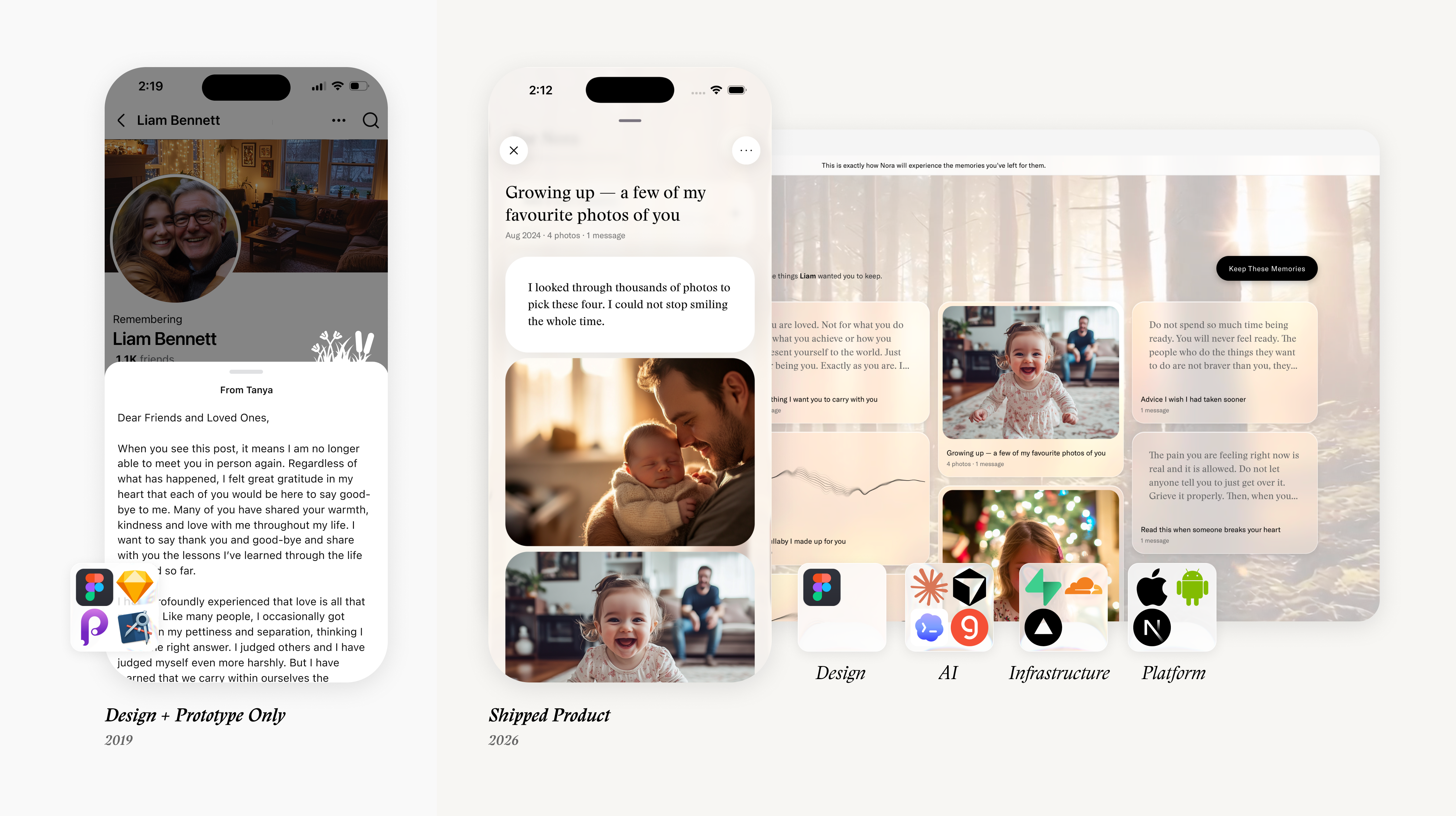
AI was part of the process throughout, but not as a replacement for the thinking. The Figma MCP connector kept design and code in sync without me having to manually translate between them. Working with Claude meant I could go from a design decision to a working screen in the same sitting. The gap between what I intended and what got built stayed small in a way that's hard to achieve even on a team. The same was true for exploration: when I wanted to try a different visual direction or work out how an interaction should feel, I could have a working version in front of me before I'd finished thinking through the idea.
The two prototypes above are a good example. The Figma version on the left was a real design — not a rough sketch — but something wasn't quite delivering. Instead of reworking it in Figma, I took the changes I wanted to attempt straight to Claude and had a working version in the simulator within minutes.
But there's a hard limit to what AI could do here. Should memories be organized by type — photos, audio, text — with tabs and horizontal scroll, or does that separation work against the experience and everything should live in a single vertical flow? Those were judgment calls no tool could make. In a product that has to reach people at a deep emotional moment, getting them wrong doesn't just hurt the experience. It breaks the trust the product is built on.
Stack: React Native (Expo SDK 55), Next.js, Supabase, Vercel, Figma, Groq Whisper, Claude (Sonnet), ElevenLabs.
When someone passes away suddenly, the people left behind often struggle to move forward — not because of logistics, but because there was no goodbye. No closure. Research on Prolonged Grief Disorder points to the same thing I heard directly from people in grief support groups: what survivors wanted most was more words from the person they lost.
The tools that exist today don't address this. Estate planning focuses on assets. Social media memorials are improvised. Nothing is built specifically to help people leave something meaningful behind — for the right person, at the right time.
That's the gap Stillwith is designed to fill.
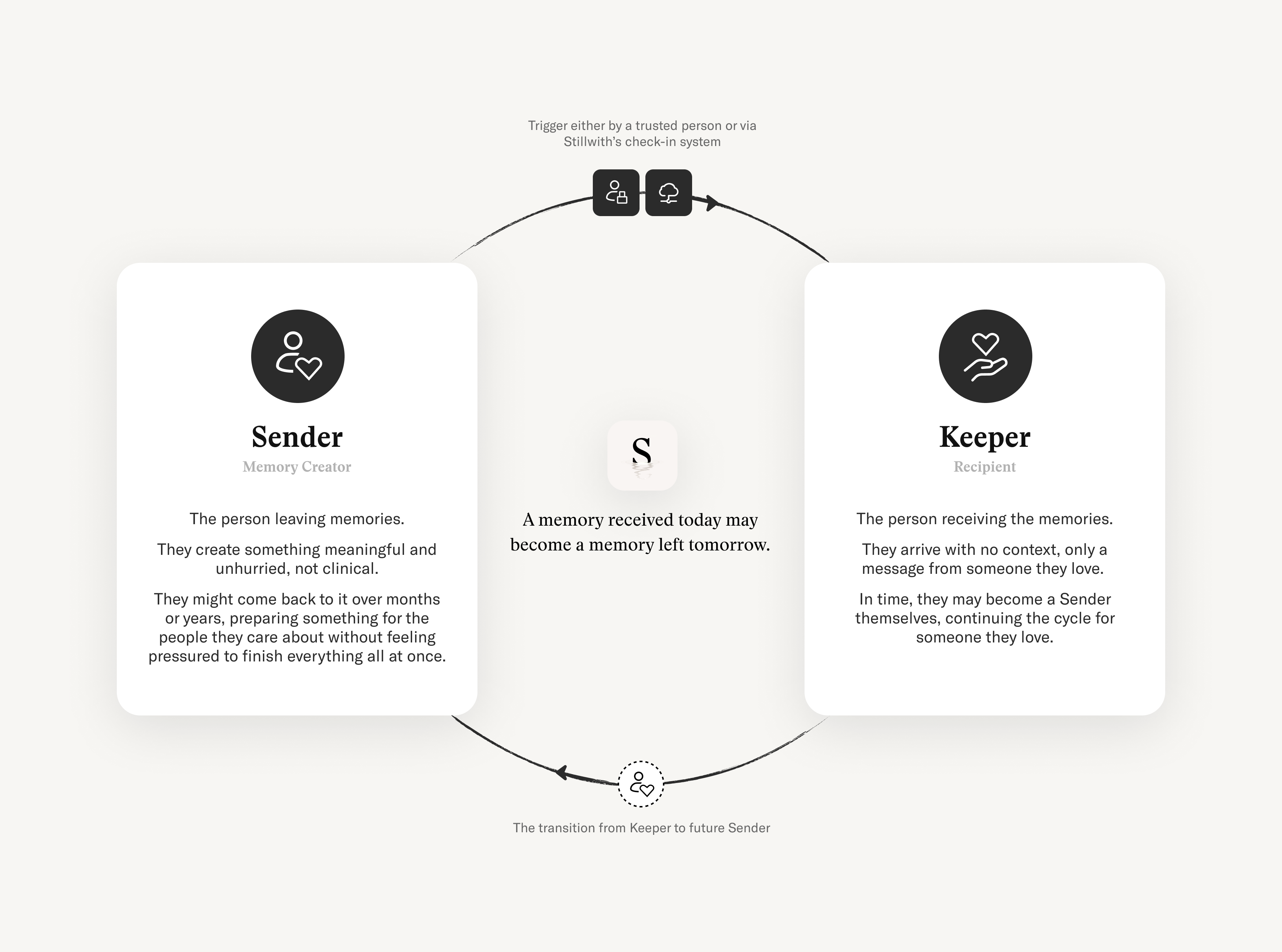
The person leaving memories. They need an experience that feels meaningful and unhurried, with no pressure to finish everything at once.
The person receiving memories. They have no relationship with Stillwith and may be actively grieving when the first memory arrives. The experience has to earn their trust in seconds — through the person they lost, not the product. Some Keepers will want to do the same for the people they love.
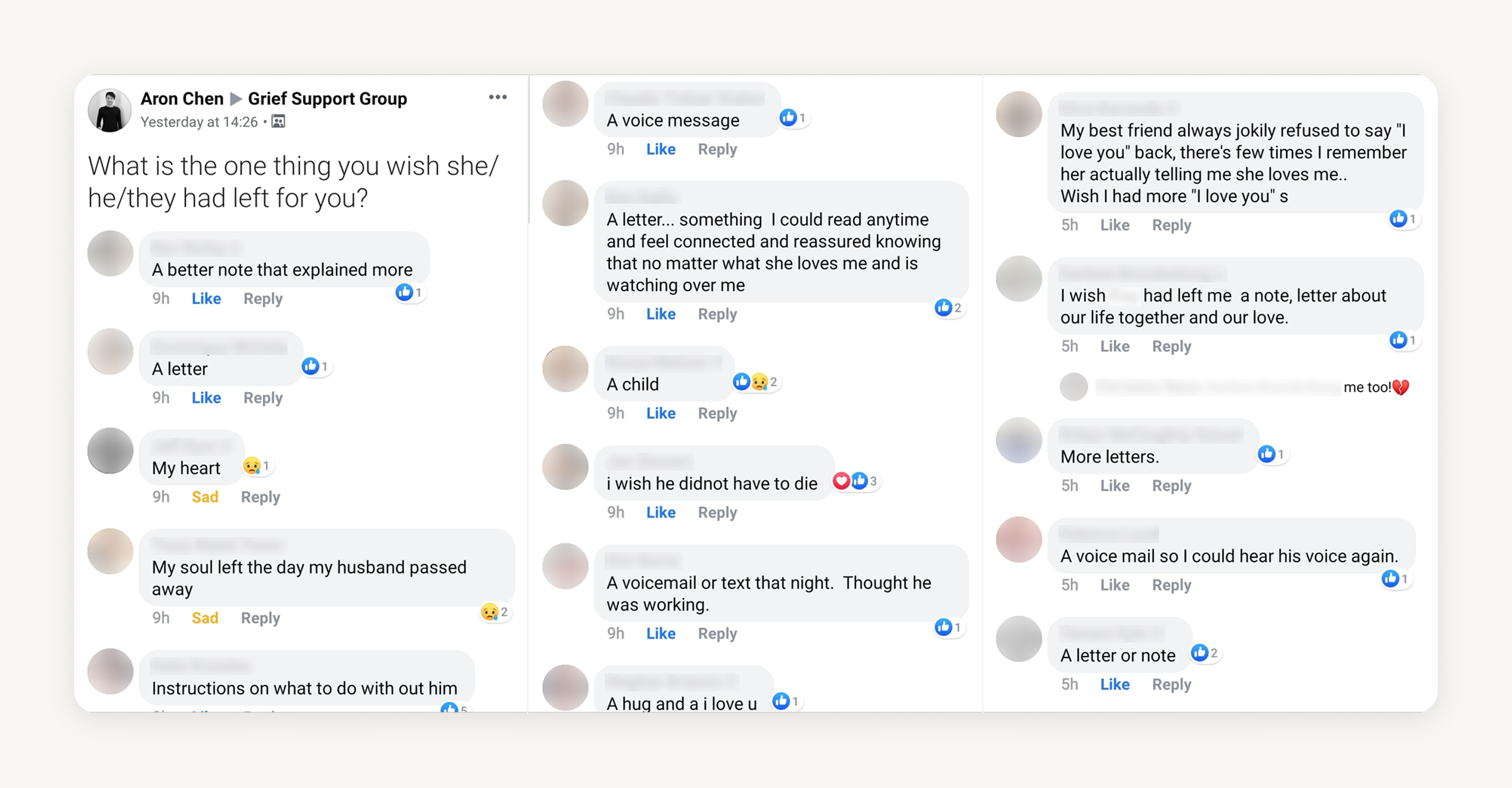
During university, I asked a Facebook grief support group what they wished a loved one had left behind. The responses were consistent: words, voice messages, letters, a simple goodbye.
That research shaped Stillwith's core decisions: voice as the primary medium, memories addressed to specific people, and a Keeper experience built around receiving something personal rather than browsing a memorial.
The wish to stay connected after someone dies is not unusual. In a study of 70 bereaved people published in OMEGA — Journal of Death and Dying, 81% described after-death communication as comforting, 84% found it helpful in their bereavement, and 61% expressed a desire for continued contact with the person they lost.
The evidence points to something important: people are not simply trying to let go. Many are trying to keep feeling close. Stillwith does not simulate that connection. It preserves the real thing: actual words, an actual voice, recorded while the person was still here.
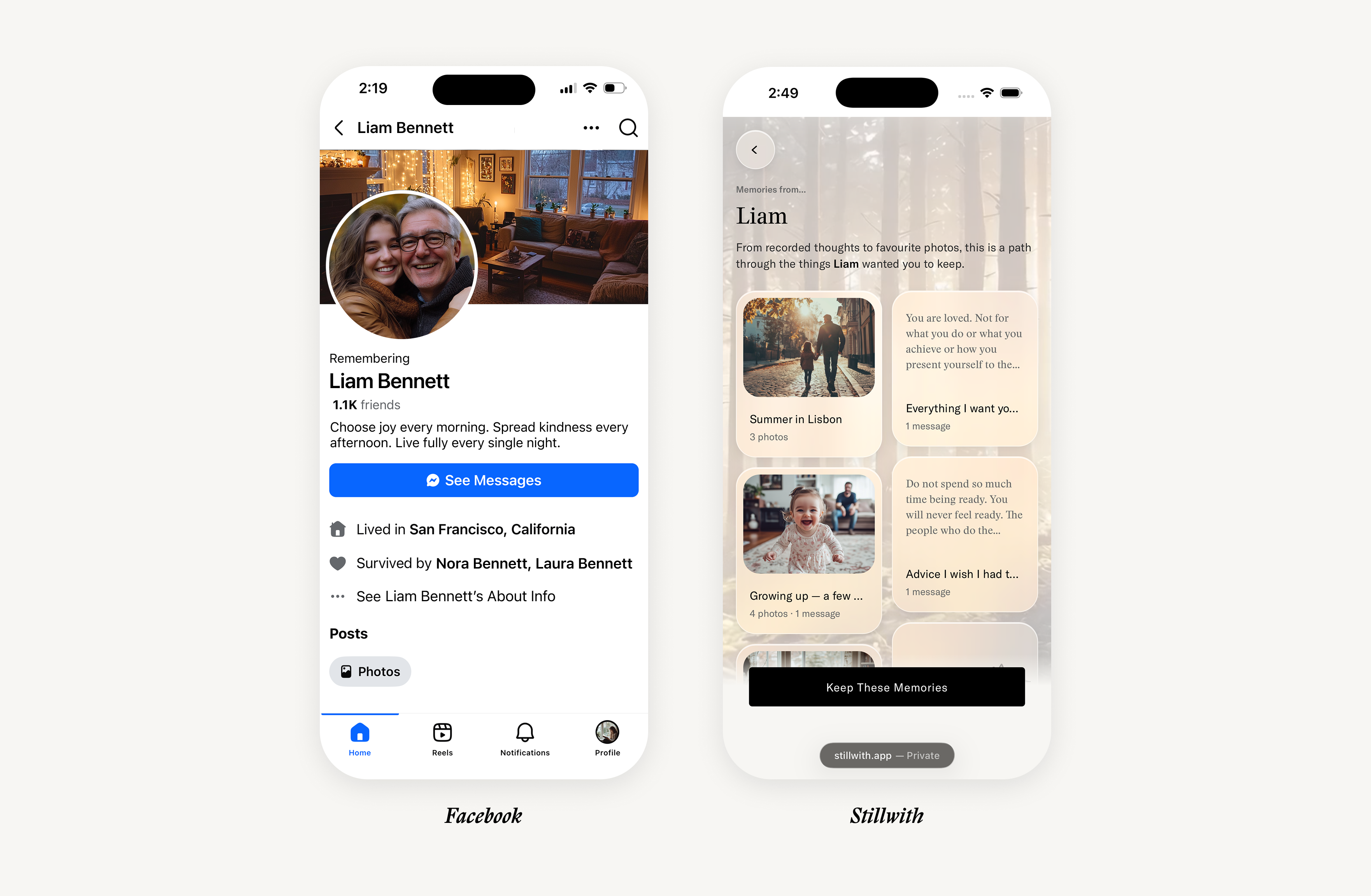
When people grieve on social media today, they're often working with content that wasn't always meant for them. A deceased person's Instagram shows holiday photos shared publicly with everyone. Facebook's memorialization features give the bereaved a place to post about the person — but nothing gives the person a voice. What's there wasn't always curated for you specifically, and you have no control over when it surfaces. The algorithm decides when you're reminded.
Stillwith is different in one specific way: everything inside it was recorded by the person, for you, on their terms. Not a window into a life — a message addressed to you.
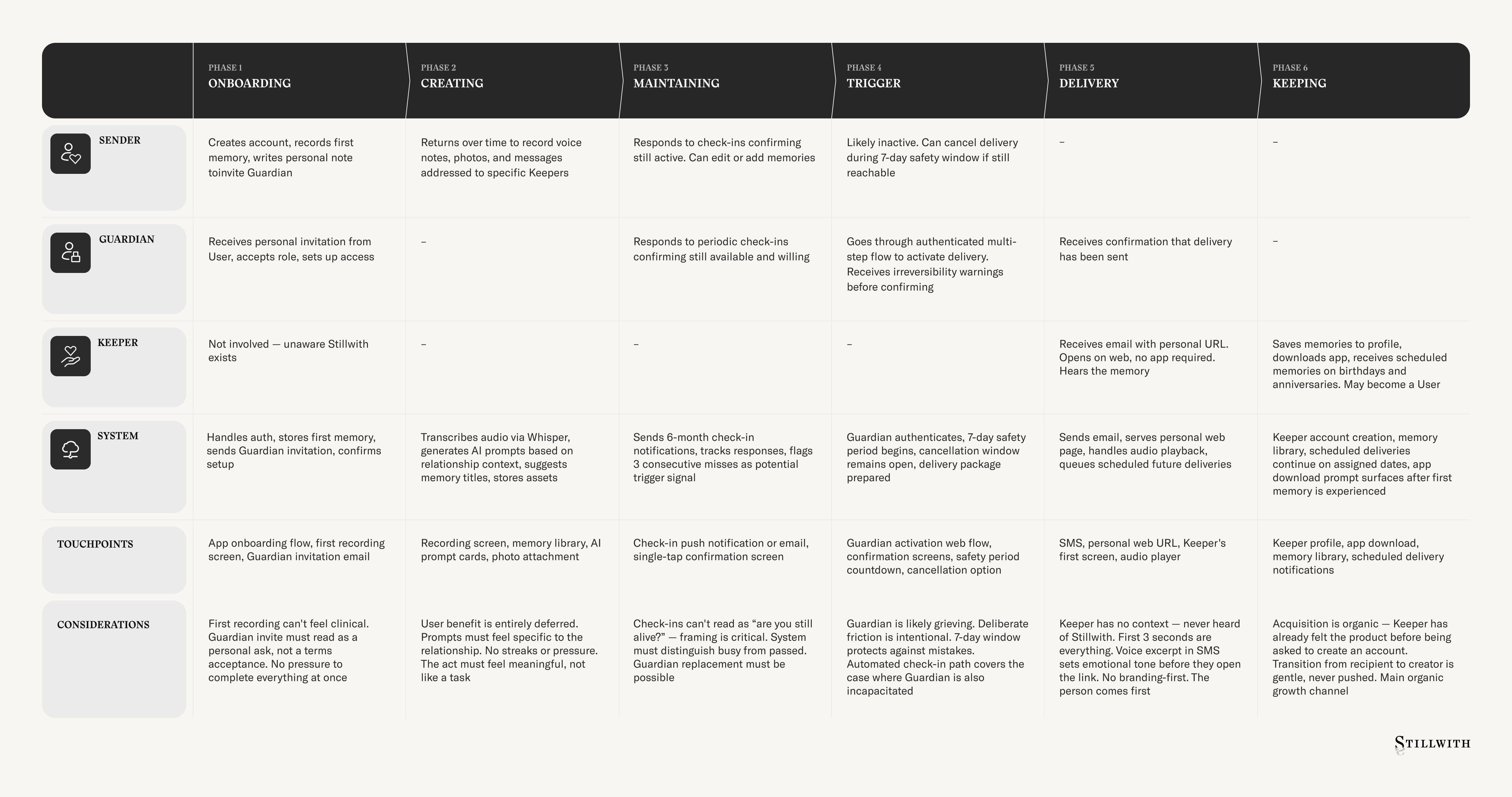
The User creates an account and records their first memory. Delivery setup stays optional until they are ready.
The User records voice notes, attaches photos, and writes messages. AI helps with transcription, titles, and prompts.
The User comes back over time. Periodic check-ins confirm they're still active.
Delivery is triggered by a Guardian or by missed check-ins. A 7-day safety period runs before anything is sent.
The Keeper receives an email with a personal URL and a short transcribed voice excerpt. No account is required; the memory comes first.
The Keeper can save memories to a profile and, if they choose, become a Sender for someone else.
Four principles guided every design decision in Stillwith, derived from the brand and from what this product needs to earn emotionally.
Every interaction feels personal, never clinical or transactional. Stillwith is not a filing system for memories. It's the closest thing to sitting with someone.
Silence and space carry as much weight as content. The product resists the instinct to fill every moment with UI, prompts, or features. Less on screen means more emotional room for the user.
The design should endure the way a handwritten letter does, not trendy, not branded with the aesthetic of a particular year. Memories recorded today may be received decades from now.
Users are sharing their most private selves. Everything from data handling to copy tone needs to earn that trust, not assume it.
These principles became constraints: no gamification, no dark retention patterns, no trend-driven visuals, and no generic product copy.
The interface is kept minimal so the memory is always the loudest thing on screen, not the UI holding it, in line with the restrained design principle. The video background with ambient sound was a deliberate choice to let the environment carry emotional weight before anything is tapped. I'm aware that autoplay audio is generally considered poor UX, and that glass cards on moving backgrounds introduce real accessibility risks around contrast. These are tradeoffs made for a specific context: Stillwith is opened in private, quiet moments, and the atmosphere needs to do emotional work the interface can't. A single background also assumes too much about what feels resonant to each person, which is why this was designed as a system from the start. The intent is to expand into user-selected environments so the scene can reflect whoever they're remembering, not just a default.
The Keeper has never heard of Stillwith. They may be grieving. And they are about to receive something deeply personal from someone they've lost.
The design goal was simple: connect them with the person, not the product. The Keeper receives an email containing a short transcribed excerpt from the voice recording — the first thing they read is something in the voice of someone they miss. When they open the link, the memory is already there. No account prompt, no onboarding, no brand-first explanation.
Leading with the voice rather than the product is the single most important design decision in Stillwith. If that moment fails, nothing else matters.
The Keeper experience is web-based so the first memory can be opened immediately, on whatever device they have. No app store, no setup, no extra task at the worst possible moment.
The app comes later, after the Keeper has already felt why Stillwith matters.
A recording carries tone, warmth, pauses, and rhythm in a way writing cannot. That is why the recording button is the most prominent action in memory creation.
The interface makes a deliberate point: start with your voice. Writing and photos are still available, but audio sets the emotional center.
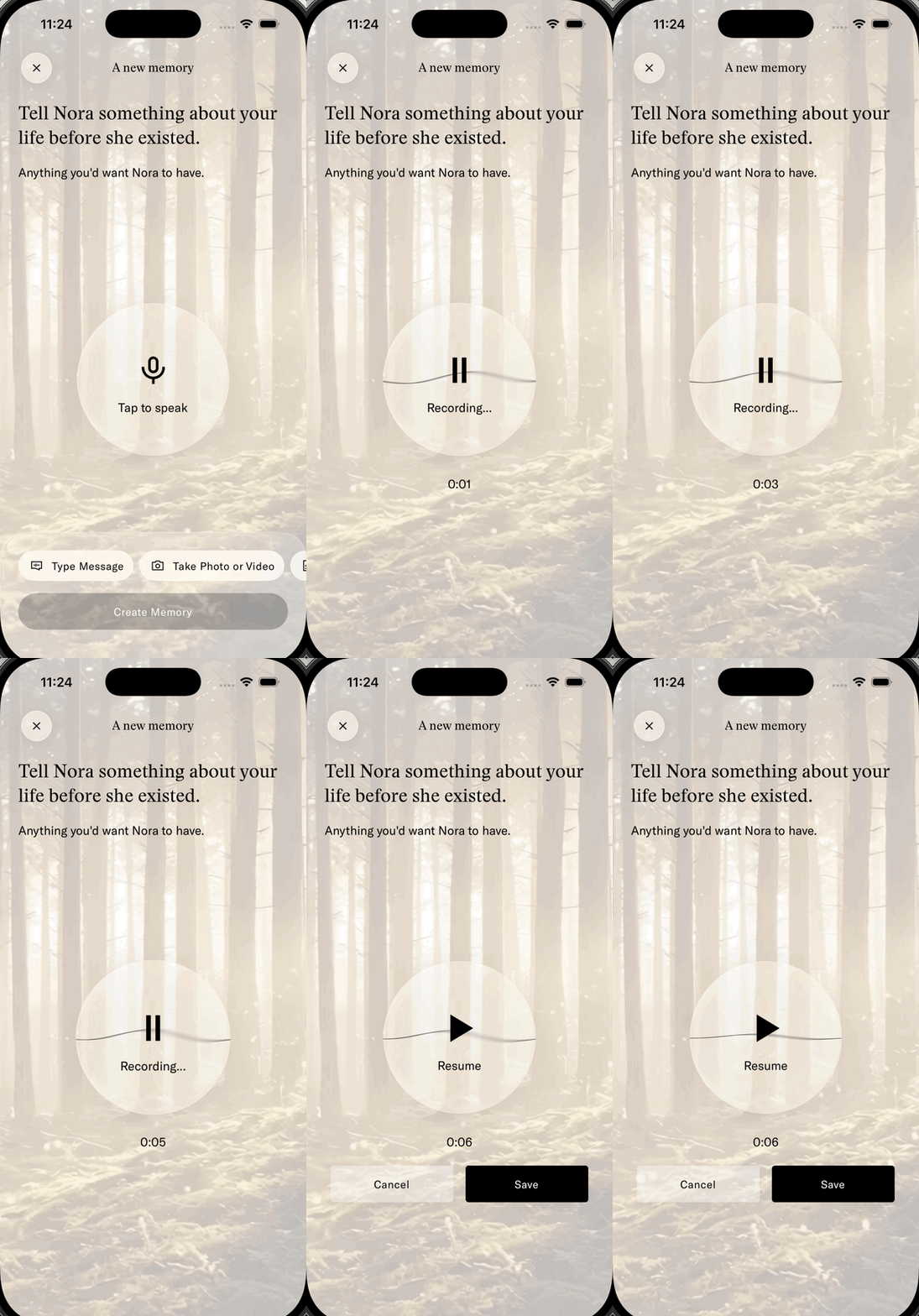
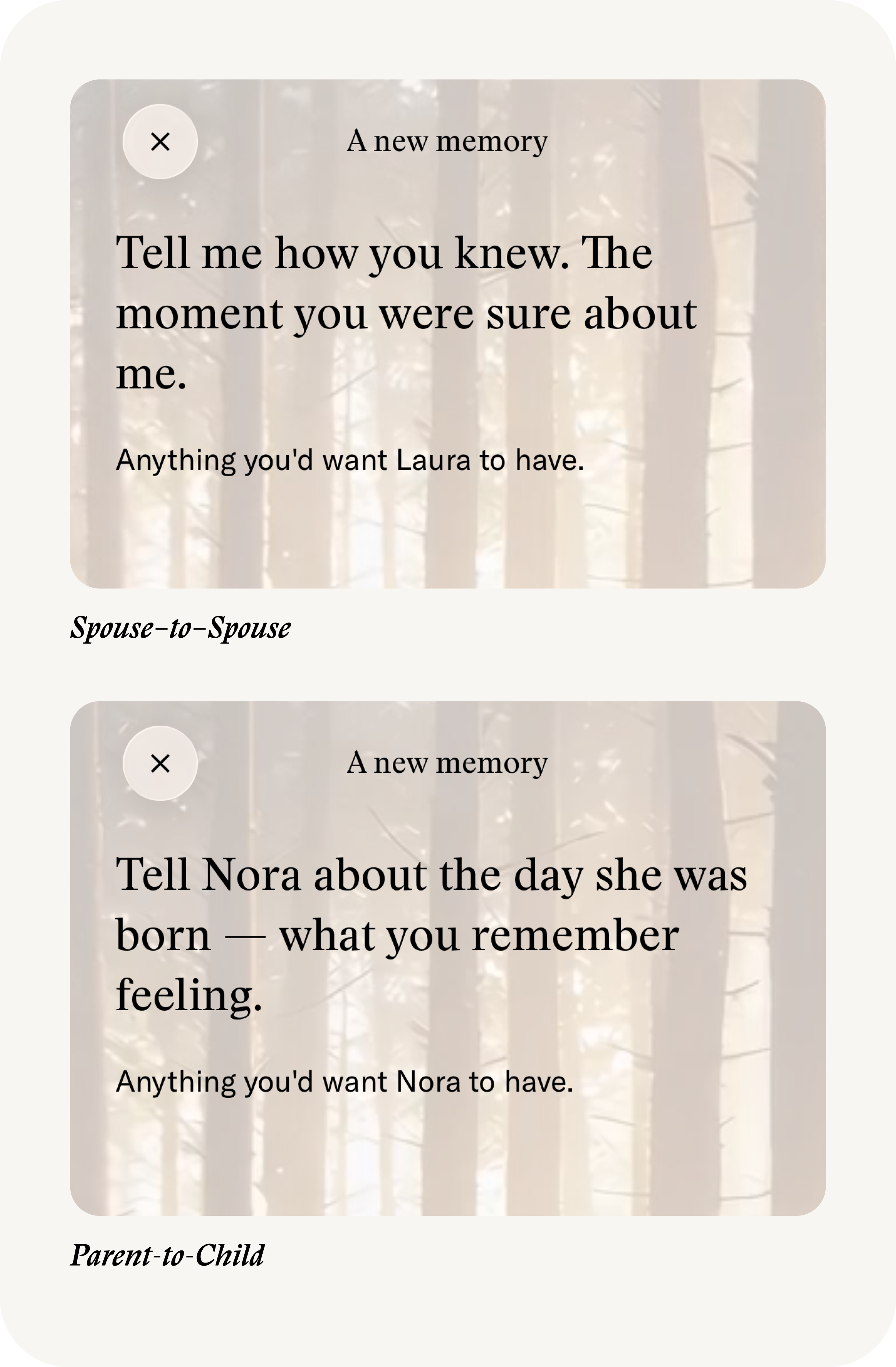
The hardest part is starting. The benefit to the Sender is deferred, sometimes forever, so the product has to make creation feel lighter.
AI prompts offer specific questions based on the Keeper, the relationship, and what has already been recorded. The goal is not more content. It is one meaningful next memory.
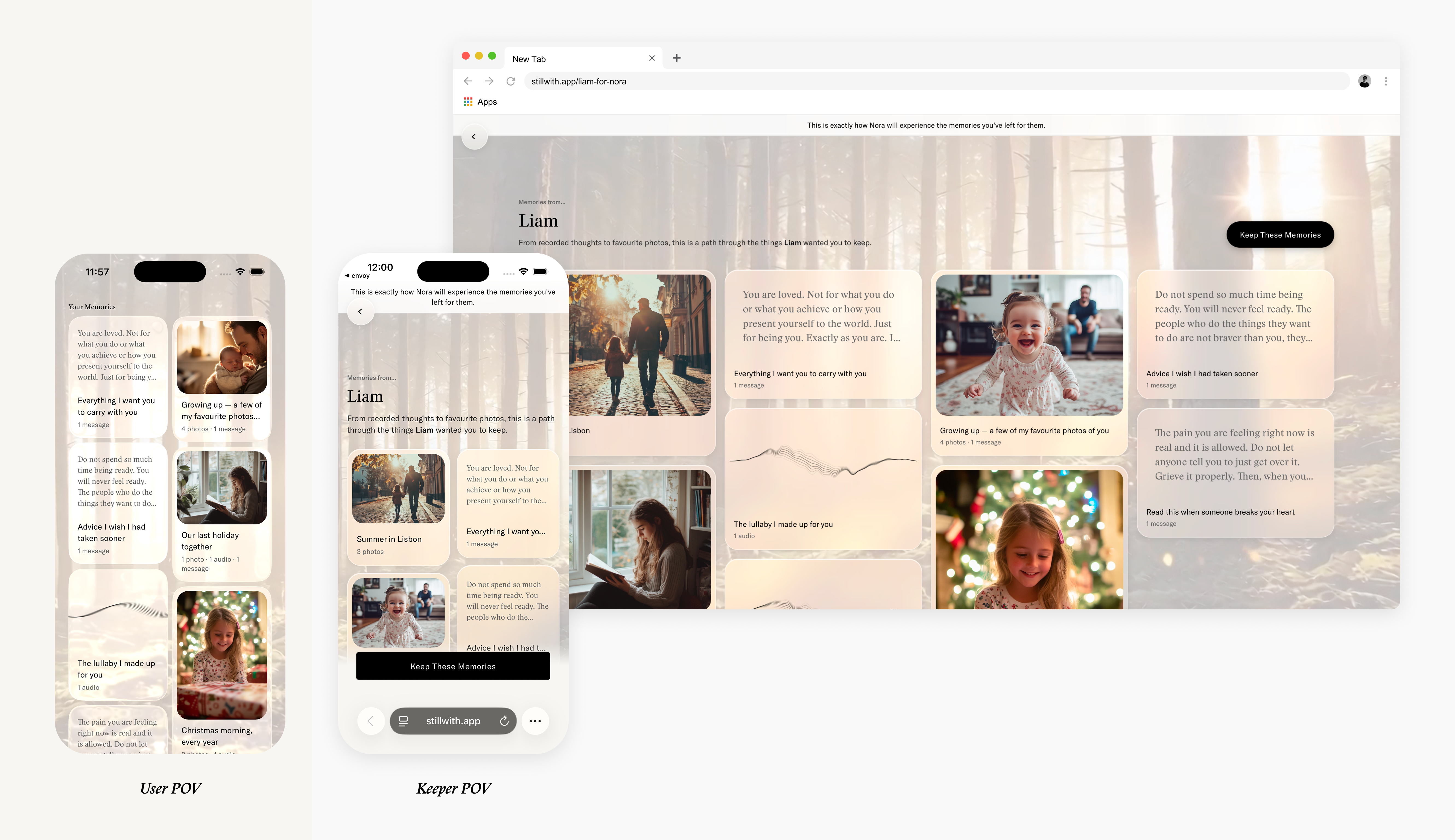
Because the User's benefit is so deferred — and because they may never experience it themselves — it's genuinely hard to stay motivated to keep creating memories. The preview feature addresses this directly.
Before anything is delivered, the User can see what their Keeper would receive: the layout, the voice, the photos, and how the memory comes together. Seeing it from the other side turns an abstract act of care into something they can feel.
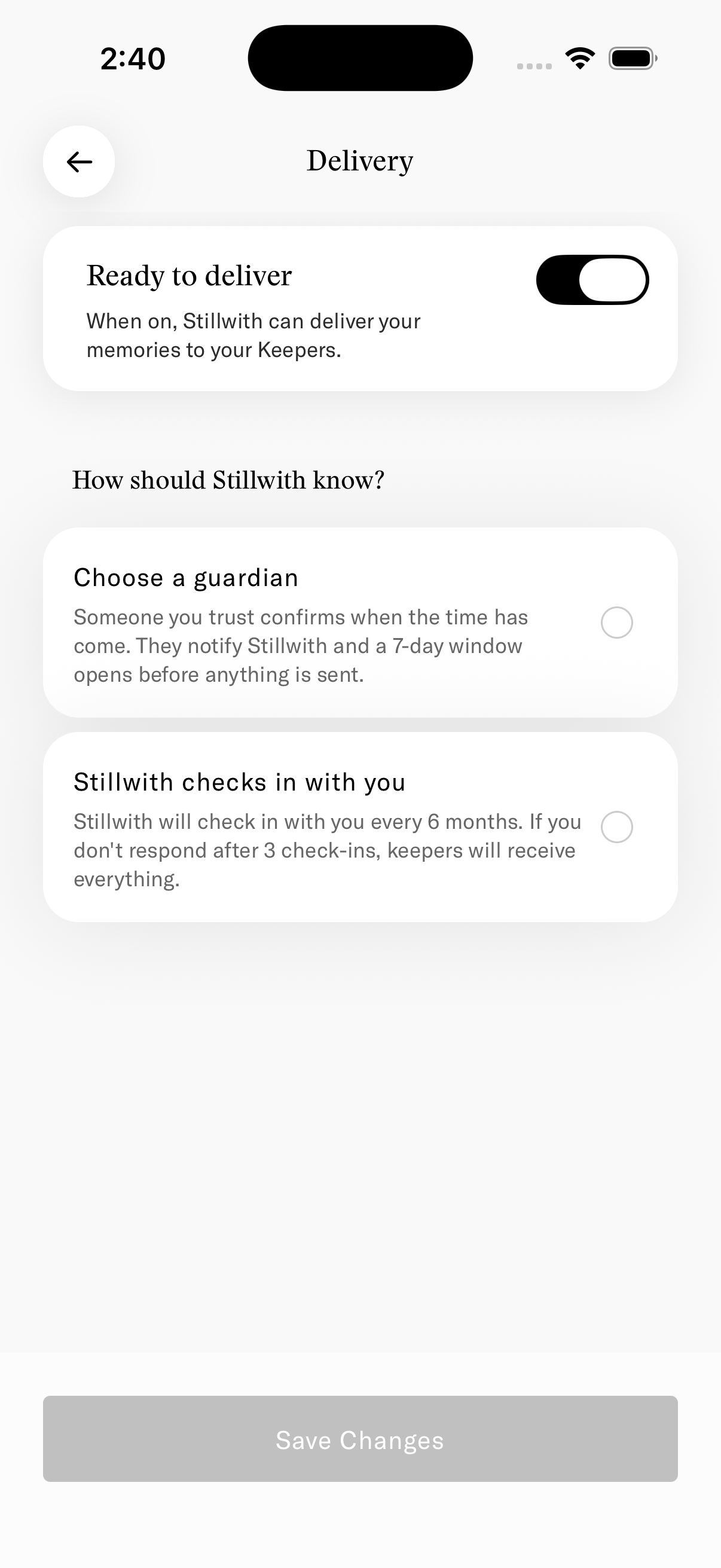
Delivery is the most consequential part of Stillwith, so setup needed to feel light. Users can create memories privately, then turn delivery on only when they feel ready.
Once delivery is on, Stillwith offers two trigger paths: a trusted Guardian, or automated check-ins. The Guardian path keeps a human in the loop, but it can ask a lot of someone who may already be grieving.
The automated path reduces that burden. Stillwith checks in every six months, and only triggers delivery after three missed check-ins — enough to signal a pattern, not a single busy week.
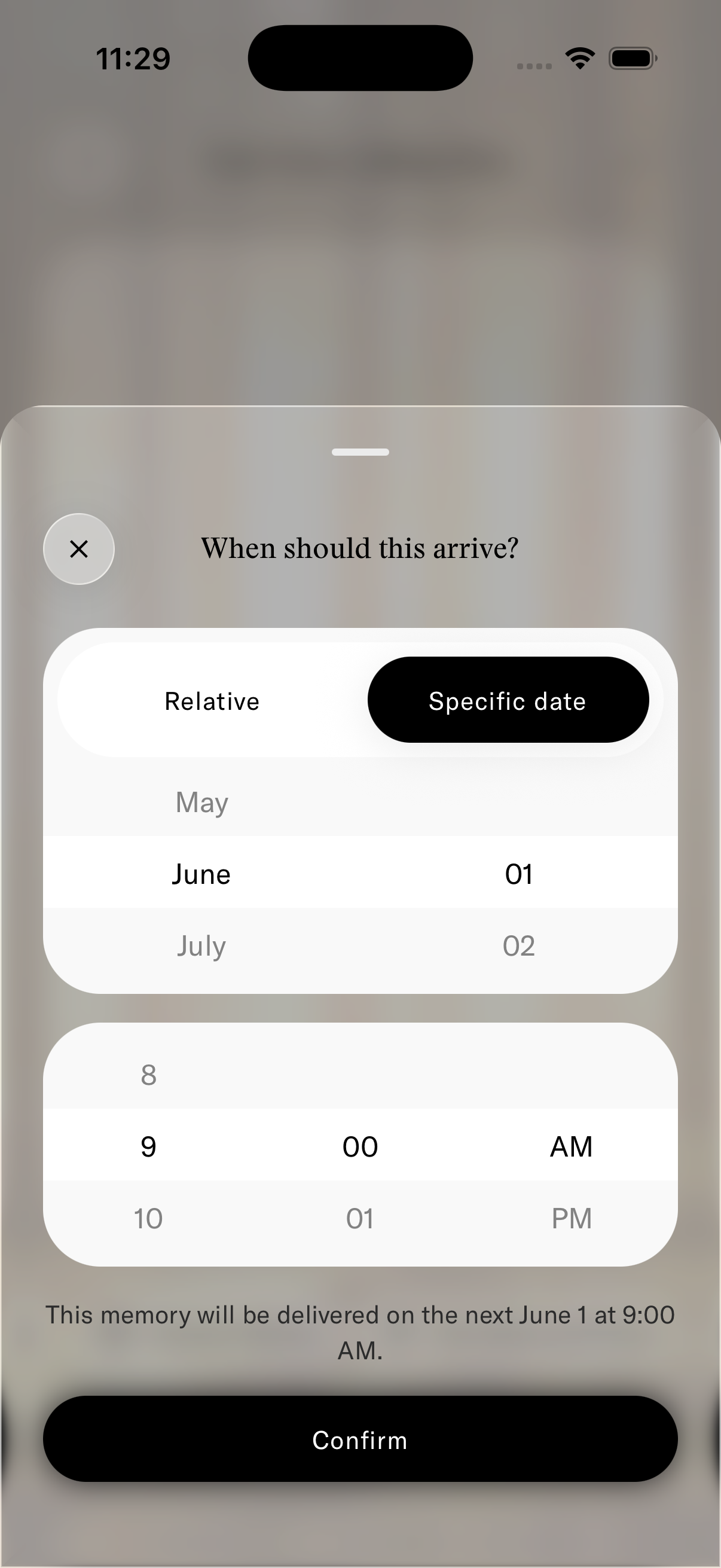
Grief doesn't hit evenly. The hardest days are often the predictable ones — a birthday, a holiday, an anniversary. These are also the moments when hearing from someone you loved would mean the most.
Users can schedule memories for those moments: a birthday voice note, a graduation message, a note to a partner on an anniversary. Even if they cannot be there, they can still show up.
Once memories are delivered, they cannot be taken back. That shaped the entire trigger flow. In this context, getting it wrong is not just a bad experience. It is a harm.
Friction became a feature:
The goal was to let deliberate action move forward, while making accidental action naturally pause.
This is a product where slower is better. That meant rejecting many defaults of consumer software: streaks, read receipts, badge counts, urgency, and “your memory is waiting” notifications.
Those patterns are built for return frequency. In grief, they become pressure. A notification reminding a Keeper that a memory is waiting — before they are ready — is not engagement. It is an intrusion.
The same logic applies on the Sender side. There is no memory count, no progress bar, no implied goal the product is nudging you toward. Prompts are offered, not pushed. The check-in cadence is every six months, not weekly. The product's job is to stay out of the way and be easy to return to — on the User's terms, not the product's.
Prior research validated the need. The next question is whether Stillwith's mechanisms actually work: can prompts help Senders create, and can delivery feel careful when it matters most?
Do prompts help Senders return and record over time? Evaluate: return recording sessions after a prompt is received.
This toggle is the emotional threshold. If it never turns on, nothing is delivered. Evaluate: activation rate and reasons for hesitation.
When receiving a memory moves someone to want to leave one for the people they love, the product has done something real. Evaluate: of those who receive a memory, how many go on to create their own for someone else.
Guardian or automated check-in: the chosen path reveals how people trust the system. Evaluate: path selection and completion rate.
Some people record immediately. Others need time. Track and learn; don't optimise for speed.
Upgrade moments show where value becomes clear: more memories, video, or commitment to the act. Evaluate: upgrade rate and preceding action.
Building Stillwith changed what I think is possible for a designer. A few years ago, taking an idea like this from research to a working mobile and web product would have been almost impossible for one person. With AI, agents, and modern development tools, that gap is much smaller.
But the tools did not make design thinking less important. They made the quality of the idea matter more. AI can generate, translate, debug, and build — but it cannot decide what is worth building, where emotional friction belongs, or how a product should behave inside someone's life. Stillwith only holds together because those decisions came from somewhere considered.
What surprised me most was realising I was not just designing the product. I was also designing how I worked with the tools — shaping the prompts, agents, and workflows that made the process possible. That is a genuinely new design skill. The ability to direct an AI pipeline toward a specific emotional outcome, not just a functional one, is not something the tools do on their own.
It also clarified the limits of the medium. My earlier Facebook Post Memorialization project was a design proposal inside someone else's ecosystem — one I still could not simply build into, even with today's tools. Platforms, permissions, and ownership still define what can exist. Stillwith was different: I could define the whole system — product, service model, delivery flow, and the emotional boundaries around all of it.
The designer's job did not disappear. The medium changed. The responsibility to make thoughtful decisions did not.